2026: Want a "10x Human"? Fix Your Communication
Many of us are racing to become "10x humans" through AI, leveraging LLMs to automate tasks, generate code, and streamline workflows. In our pursuit of speed, we often overlook the most fundamental human challenge: sharing context, communicating intent, and building a truly shared understanding.
The "Spec-Driven Development" (SDD) Mirror
A recent workshop observation by Martin Fowler illustrates this point. He noted that even among seasoned professionals, discussions around "Spec-Driven Development" (SDD) quickly become fragmented. Despite using the exact same term, participants often understood something different under it.
This isn't an isolated incident. Whether it is SDD, Agile, TDD, or a "Prototype," labels often hide a significant gap in shared meaning.
The Everyday Language Trap
We tend to assume these misunderstandings are unique to technical jargon. They are not. We fall into the exact same trap with everyday words:
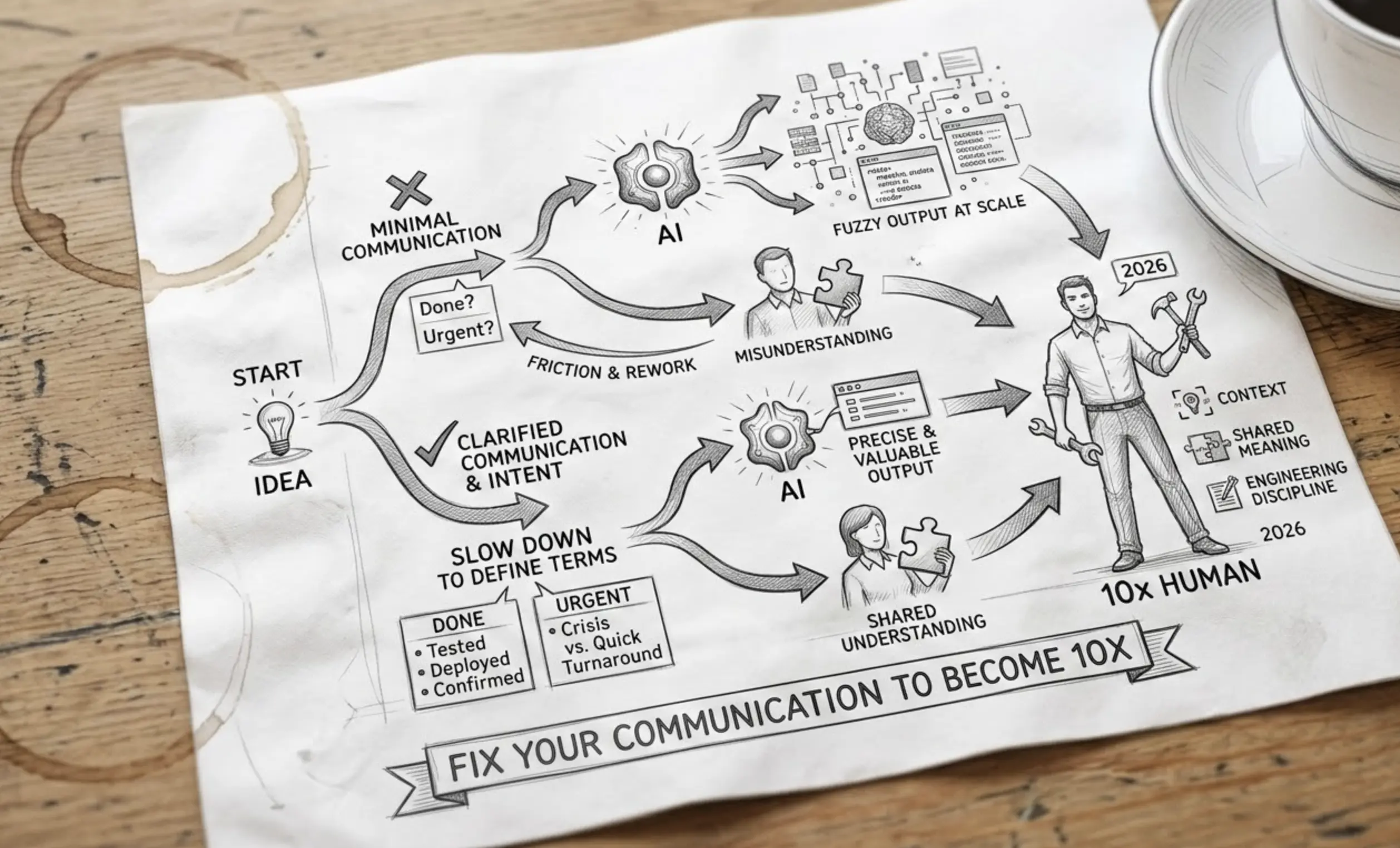
- "Done": Does it mean functional, tested, and deployed, or merely that work has paused?
- "Urgent": Is this a crisis situation, or just a desire for a quick turnaround?
- "Common Sense": What is "obvious" to one person is often invisible to another.
When we use these terms without clarification, we build our work on a foundation of hidden assumptions rather than shared context.
The Cost of Cognitive Shortcuts
The human brain is wired to conserve energy. As Daniel Kahneman outlines in Thinking, Fast and Slow, our intuitive (System 1) thinking pushes us to take shortcuts. In professional settings, this manifests as "minimal communication."
We often convince ourselves that we are moving faster by skipping the early, uncomfortable work of defining our terms. In reality, we are trading a small amount of upfront effort for massive, hidden uncertainty.
When we skip this elaboration, we invite future friction:
- Features that are technically correct but functionally useless.
- Misaligned expectations between stakeholders.
- Costly rework that could have been avoided with a brief alignment discussion at the start.
The AI Multiplier
This communication deficit is not new, but AI has turned it into a critical failure point.
When you work with a human, they may intuitively pick up on context cues or ask a clarifying question. AI is a literal mirror. It will execute exactly what you ask for, context gaps and all. If your intent is fuzzy, the AI's output will be fuzzy—but at a scale and speed that makes the resulting misunderstandings much harder to untangle.
The Path to Effectiveness
Becoming a "10x human" in 2026 isn't just about how well you wield a prompt or how fast you can build a system. It is about how well you manage your cognitive shortcuts.
Getting our thoughts and communication straight—whether with colleagues or with an AI—is not a soft skill; it is an essential engineering discipline.
By slowing down to clarify our intent, we move faster in the long run. We avoid the "backfire" cycle, reach smarter decisions earlier, and build systems that solve the actual problems we set out to address.
Next time you find yourself using a term like "Urgent" or "Agile," stop and ask: Do they understand it the way I do?